 Submitted to ICRA 2027
1. Describe available motion
Directional bounds capture how joint limits, the robot itself, and nearby obstacles constrain local motion.
PCMS-Connect
Submitted to ICRA 2027
Being closer to a goal does not mean a robot has room to move toward it. PCMS-Connect learns which local motions remain available and uses this information to guide motion planning in narrow spaces.
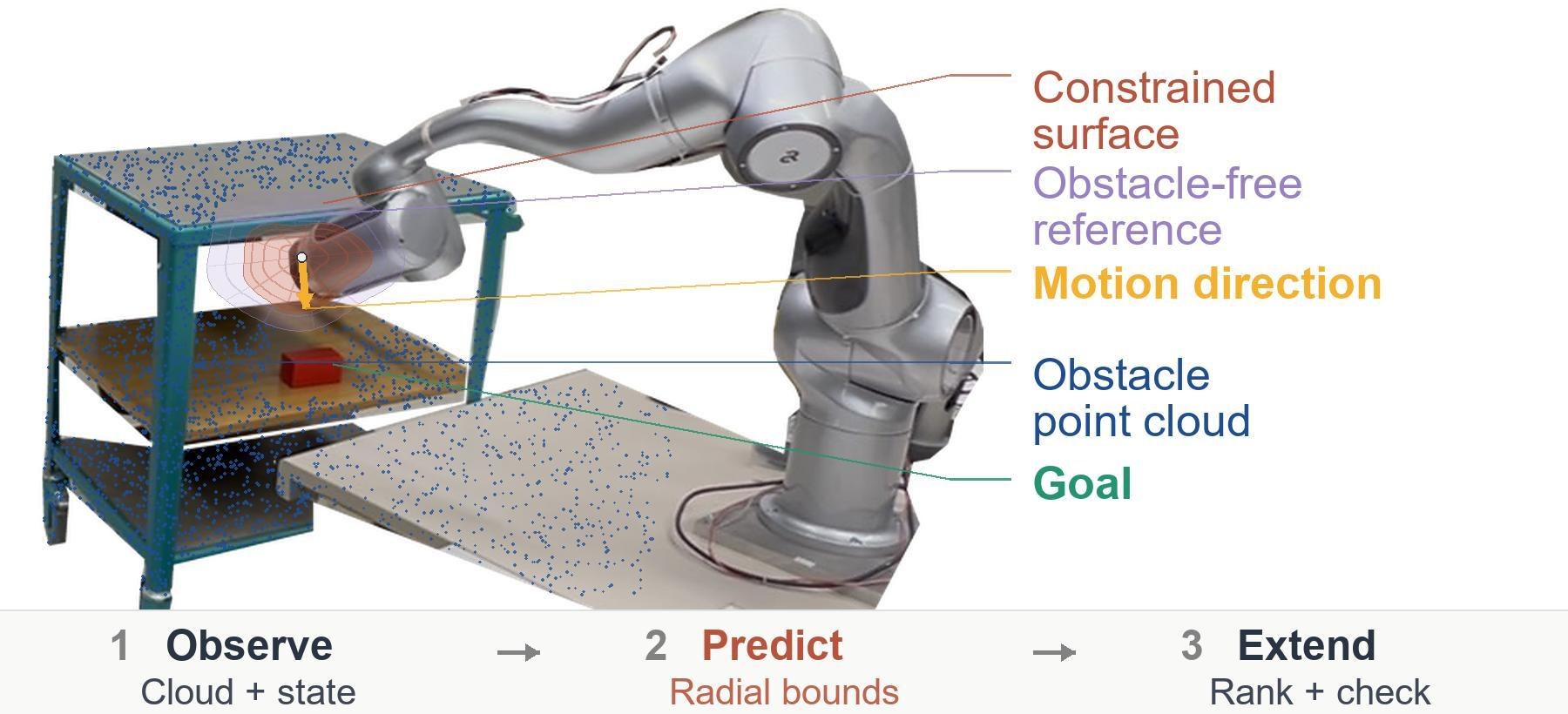
Directional bounds capture how joint limits, the robot itself, and nearby obstacles constrain local motion.
A compact learned predictor helps choose a direction and step length, balancing task progress with available motion.
Every proposed edge is geometrically checked before it extends the bidirectional RRT-Connect trees.
95.0% planning success (171/180 trials), compared with 86.1% (155/180) for goal-distance guidance across four families of Panda benchmark scenes.
39.8% lower online planning time on the 79 paired common successes in a 90-trial serial subset.
The Diana 7 demonstrations are qualitative hardware results, separate from the Panda benchmark statistics. Learned bounds guide candidate generation; finite edges still require geometric validation. The paper will be made available here at a later date.